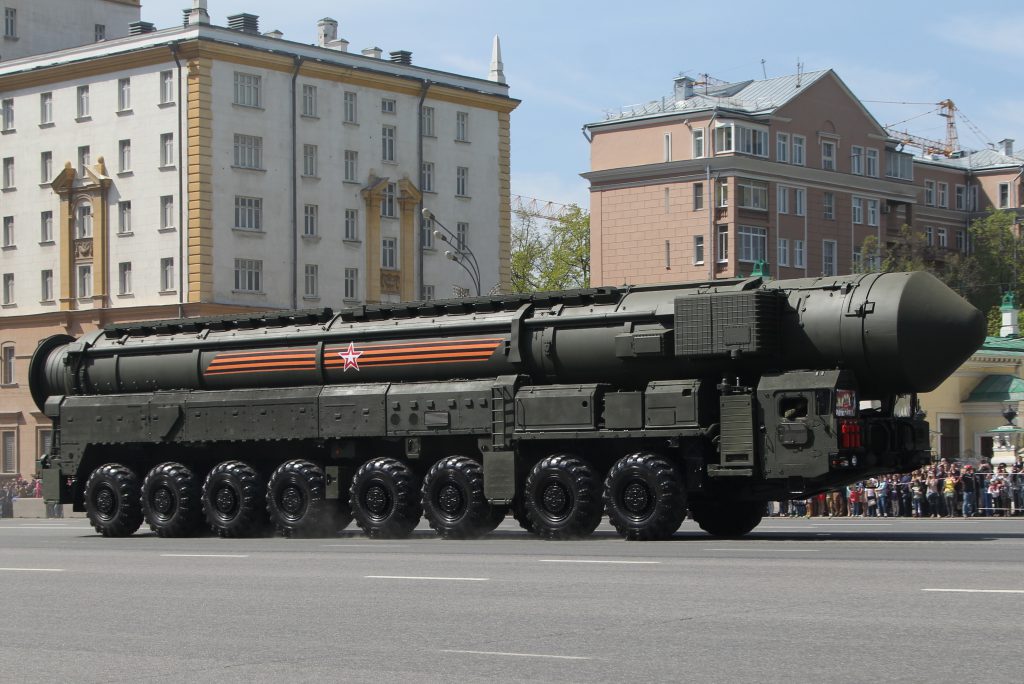
SS-18 (Wikipedia/R-36 (missile))
In this text, the main objective is tactical nuclear weapons. The purpose of strategic weapons is to support the tactical systems. When we are thinking about the difference between tactical and strategic systems the limit between those systems is lower.
The strategic missile can have tactical missions. And the strategic missile can also have low yield warheads. Also, the tactical missile can have high-yield warheads. And modern strategic missiles can also hit targets on the battlefield.
If some state has nuclear weapons. There is always the possibility that the state also uses them. There are two types of nuclear weapons. Tactical and strategic. The range of tactical nuclear weapons is about a couple of hundreds of kilometers. And the range of strategic nuclear weapons is over 2000 kilometers. When we are thinking of tactical nuclear weapons most of them are highly mobile battlefield systems that can sweep the situation away from the battlefield. The yield of the warhead of those missiles is about 1kt. to 12 kt.
During the Cold War. The Soviets planned to place medium-range R-12 (SS-4) and R-14 (SS-5) missiles in Cuba. The yield of those missile warheads was 1-2,5 mt. and the ranges of those missiles were 2000-3500 or soviet calculated the range of SS-5 about 4500 kilometers. The accuracy of those missiles was not very good. And that's why they had very high yield warheads. Those Soviet missiles had western competitor "Jupiter" tactical missiles.

Image 2) Ranges of the Soviet missiles in the Cuban missile crisis 1962
Later the other more accurate tactical systems like RDS-10 Pioneer (SS-20 "Saber"), Pershing 1 and 2, and cruise missiles replaced those first generations' nuclear weapons. Today strategic weapons like RT-23 (SS-24 "Scalpel" ) that were replaced by RT-2 PM Topol (SS-25 "Sickle") can have tactical duties. And the weapons, like "Iskander", can equip with nuclear or conventional weapons. The air-launched version of "Iskander" is "Kinzhal" that can use to attack against tactical and strategic targets.
The range of those missiles depends on the size of the warhead. The fact is that in the early years of the Cold War the yield of tactical missile warheads could be 4 mt. and the range was about a couple of hundreds of kilometers. That means those missiles could be as well as dangerous to their users as targets.
There is sometimes suspected. That some of the tactical missiles could be at the silos. For securing some routes to the countries. The tactical nuclear missile can also be a surface-to-air missile that warhead has two tactical roles. The anti-aircraft role is meant to destroy the strategic bombers and the same warheads can use against land troops.
The tactical missiles have sometimes a "police role". In those cases, the security troops will crush the rebellion in the strategic missile bases by using tactical nuclear missiles.
But as you see there are also other systems like land, ships and aircraft launched cruise missiles, nuclear mines, and nuclear torpedoes. And then the strategic missile systems. Strategic nuclear missiles are the most powerful weapons in the world. The most feared of them is FOBS (Fractional Orbital Bombardment System) which can mean the nuclear weapon that is orbiting the Earth.
There is a contract that denies placing nuclear weapons on the orbiter. But there is the possibility that this contract has been broken. So that means there is the possibility that on the orbiter are satellites that have nuclear bombs inside them.
There is also suspicion that miniature space shuttles like X-37B and MiG-105 "Spiral" can be used as an extreme version of the kamikaze drones. In those systems, there could be an internal nuclear weapon.
And the rocket can rise them to the orbiter. There is the possibility that the R-36 (SS-18 "Satan") or RS-28 "Sarmat" (SS-X-29) will equip with one smaller warhead. And that thing gives those super heavy missiles the FOBS capacity.
The most modern versions of those systems can probably return their warheads from the low Earth orbiter if those systems are not needed. All nations that have nuclear weapons have tactical and strategic weapons.
https://en.wikipedia.org/wiki/9K720_Iskander
https://en.wikipedia.org/wiki/Boeing_X-37
https://en.wikipedia.org/wiki/Cuban_Missile_Crisis
https://en.wikipedia.org/wiki/Fractional_Orbital_Bombardment_System
https://en.wikipedia.org/wiki/Kh-47M2_Kinzhal
https://en.wikipedia.org/wiki/MGM-31_Pershing
https://en.wikipedia.org/wiki/Mikoyan-Gurevich_MiG-105
https://en.wikipedia.org/wiki/PGM-19_Jupiter
https://en.wikipedia.org/wiki/R-12_Dvina
https://en.wikipedia.org/wiki/R-14_Chusovaya
https://en.wikipedia.org/wiki/R-36_(missile)
https://en.wikipedia.org/wiki/RS-28_Sarmat
https://en.wikipedia.org/wiki/RT-23_Molode
https://en.wikipedia.org/wiki/RT-2PM_Topol
https://en.wikipedia.org/wiki/RSD-10_Pioneer
Image 1) https://en.wikipedia.org/wiki/R-36_(missile)
Image 2)https://millercenter.org/the-presidency/educational-resources/jfk-and-cuban-missile-crisis