Showing posts with label Jupiter. Show all posts

Wednesday, October 11, 2023

There is CO2 in Jupiter's icy moon Europa. (Also, primitive organisms can travel between planets as spores)

  There is CO2 in Jupiter's icy moon Europa. 


There is a potential hub for extraterrestrial life in Jupiter's Europa moon. The JWST telescope found carbon dioxide from that icy moon. And that thing increases the possibility that there are some kind of primitive lifeforms under the ice of that moon. 

The CO2 emission can form in other chemical reactions. But one source of carbon dioxide emission is always lifeforms. The metabolism in cells forms that gas. That's why carbon dioxide emission on Europa moon is interesting and same time scary thing. 

If there are some kind of lifeforms under the ice of those icy moons those lifeforms could be similar to lifeforms that live around the black smokers at the bottom of the ocean. And that possibility causes re-estimation about the possible manned- or unmanned flight to those moons. If there is some kind of life forms. It's a risk. That Earth viruses infect those lifeforms. There is a possibility that the virus stays "alive" or can keep its ability to transfer genomes to other species over a long journey. 

Otherwise, those lifeforms might infect humans. When we are dealing with extraterrestrial lifeforms, we are facing things that we can't imagine. We have no idea what kind of lifeform that thing is. And we don't know anything about how it exchanges its genomes. Only one virus from Earth could be devastating to those lifeforms. But otherwise, those primitive lifeforms can infect people, who work with the samples. 
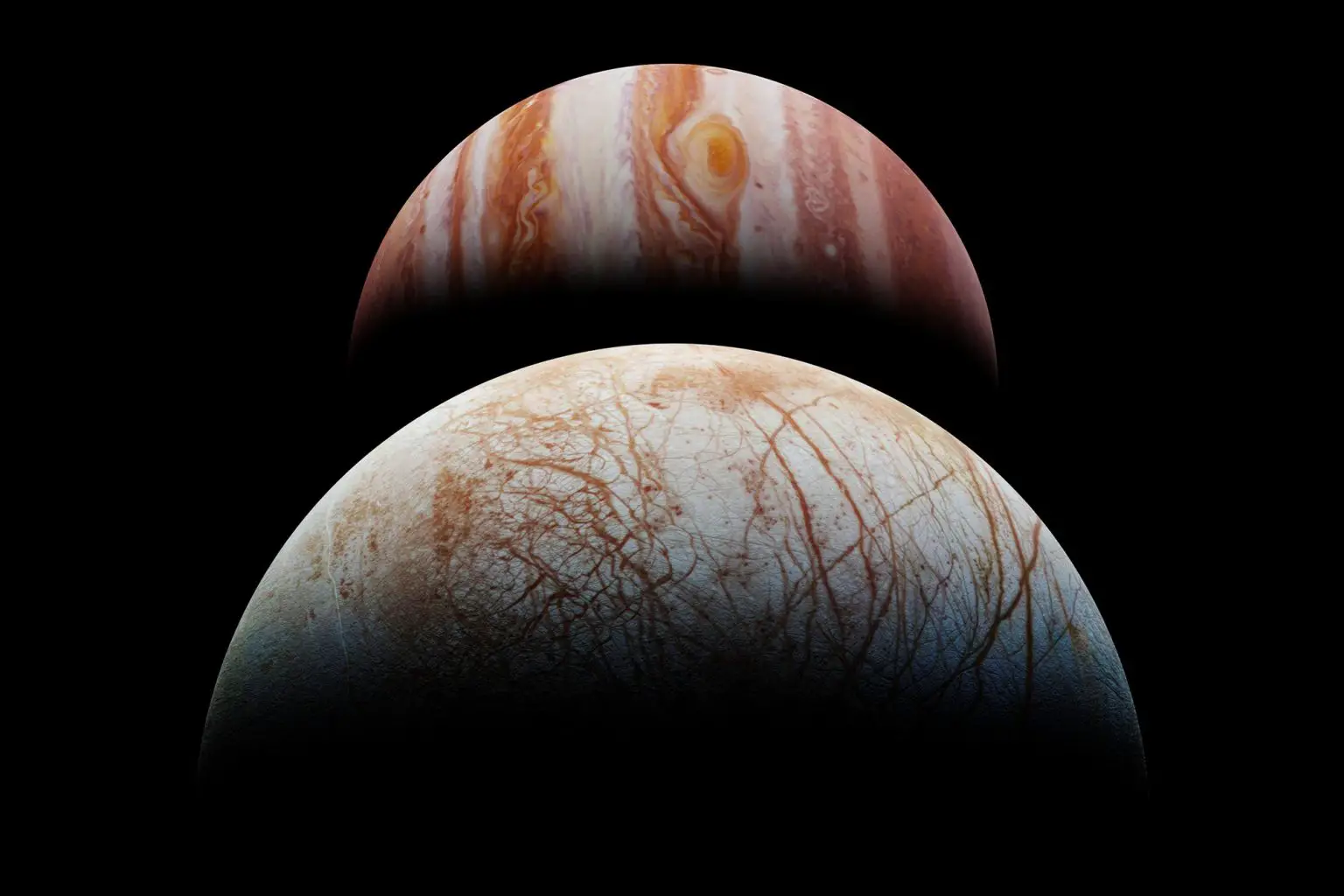


"Observations from the James Webb Space Telescope have led two independent studies to suggest that the CO2 ice on Jupiter’s moon, Europa, originates from its subsurface ocean. These findings offer new insights into the composition of Europa’s internal ocean, which is considered a prime target in the search for extraterrestrial life." (ScitechDaily/Potential Hub for Extraterrestrial Life: Webb Observations of CO2 on Jupiter’s Moon Europa)


"This graphic shows a map of Europa’s surface with NIRCam (Near Infrared Camera) on NASA’s James Webb Space Telescope in the first panel and compositional maps derived from Webb’s NIRSpec/IFU (Near Infrared Spectrograph’s Integral Field Unit) data in the following three panels. In the compositional maps, the white pixels correspond to carbon dioxide in the large-scale region of disrupted chaos terrain known as Tara Regio (center and right), with additional concentrations within portions of the chaos region Powys Regio (left). The second and third panels show evidence of crystalline carbon dioxide, while the fourth panel indicates a complexed and amorphous form of carbon dioxide. Credit: NASA, ESA, CSA, Gerónimo Villanueva (NASA-GSFC), Samantha K Trumbo (Cornell University), Gerónimo Villanueva (NASA-GSFC), Alyssa Pagan (STScI)" (ScitechDaily/Potential Hub for Extraterrestrial Life: Webb Observations of CO2 on Jupiter’s Moon Europa)

Also, primitive organisms can travel between planets as spores


Also, primitive organisms can travel between planets as spores. And that makes it possible that red dwarfs can be multi-planet ecosystems. That requires that the sender planet's gravity is weak enough that spores will travel out from its gravity field. And the other planet's position or gravity field must be that those spores will travel to that other planet. 


By the way, it's possible that the fungi. Or anthrax-bacteria-type lifeforms can send spores between planets. Cosmobiology experts created a model for interplanetary ecosystems for red dwarfs. And their planetary systems. Those planetary systems are small. And their star is colder than the Sun. So that is why bacterial spores can travel between those planets. 

There are observations that Callisto- moon's atmosphere contains CO2. There is also organic dust on those moon's icy shells. And there is a model. That there could be a Gaia-type-organism. That could exchange genomes between those Galilean moons. 

It's possible. Primitive lifeforms can travel between planets. Researchers can use the same model for all closed planetary and subplanetary systems like Jupiter's moons. If there are similar chemical and physical environments. Those planetary systems are smaller and their star is colder than the Sun. And there the bacteria spores can survive longer time than in our solar system. And in those solar systems organisms can exchange genomes between planets. 

There are also three other moons around Jupiter with oceans below their shell. In some models. There are primitive organisms also under those other Galilean moon's icy surfaces. Maybe those lifeforms are like fungi or anthrax bacteria that can create spores with very high survivability. The distance between Galilean moons is not very long. 

And that thing creates a model. That those lifeforms can exchange their genomes through space. The idea is that primitive lifeforms can send spores between the lifeforms on different moons. Those Jupiter's moons are quite close to each other. And the bacteria spores can easily survive over those distances. So it's possible that also primitive lifeforms can send living spores through space. And those spores can be viruses that can transform other lifeforms into another. 


https://scitechdaily.com/potential-hub-for-extraterrestrial-life-webb-observations-of-co2-on-jupiters-moon-europa/

Tuesday, May 3, 2022

How to get to Jupiter orbiter in 1 year?

From Pinterest


The Pioneer 10 flew to Jupiter in about a year. The Galileo probe used almost 2000 days for that journey. And the reason for that was simple. The Galileo probe was the orbital mission. And it should slow down its speed for reaching the orbiter. 

The total flight time of the Galileo probe was more than six years. The reason for that is simple. Galileo's flight time to Jupiter was announced from the last gravitational assists. 

While it made its mission, the Galileo probe made two gravitational assist flybys with Earth and one with Venus. As I wrote before. But is it possible to send the orbital probe to Jupiter or other planets in less than two years? There are two theoretical ways to make that thing. 


1) Main craft makes the flyby and sends the parasite probes to orbital trajectory. 


Sometimes is introduced an idea of an interplanetary or even interstellar mission is a combination of the flyby and orbital missions. The system includes two types of probes. The main probe would fly through the solar system at a very high speed. And its parasite- or sub-probes will send to orbital trajectories. 

The idea is introduced in the "Daedalus" plan. The plan was to create a massive, unmanned probe that makes flyby of the planets or other stars. And during that flyby, it sends its smaller sub-probes that use ion or nuclear engines to slow down. In that version, the smaller probe uses nuclear thermal propulsion or some other power system, to decrease its speed to a level where it can reach the orbital trajectory.

"Daedalus" (Wikipedia, Project Daedalus)


2) The other craft will dock to the main mission unit during the gravitational assist maneuver. 


This idea is a little bit more conventional than "Daedalus". The idea is to use a similar mission profile to the "Galileo probe". The larger craft will put to make gravitational assist flybys to Earth and Venus. Then the smaller probe will drive at the front of the craft. And then the larger device that is loaded with gravitational energy will drive to catch up with the smaller probe. 

The larger probe can fly between the Earth and Venus for many years. And then the other probe will dock to it. The reason, why the Galileo probe didn't use the sun as a gravitational sling. Is that the connection between the probe and mission control is cut. When it's on another side of the sun. But the modern artificial intelligence makes it possible that the probe can find Earth independently and re-establish a connection. 

If we would use that gravitational sling with manned space missions. There is a problem that the crew must wait on Earth for a very long time before their docking capsule will launch. 

When we are talking about the long-term space missions the crews are extremely well selected. Their social relations are the key element for mission success. And if one of those members will injure by accident that would be a catastrophe. 


https://www.universetoday.com/128259/long-take-get-jupiter/


https://en.wikipedia.org/wiki/Project_Daedalus

Could fast-spinning aerial vehicles be behind some UAP cases?

“The Phantom Twist drone’s unique rotation renders it almost invisible when in flight (Image Credit: Northwestern University).” (The Brief) ...