Showing posts with label exoplanets. Show all posts

Monday, November 11, 2024

The smooth material disk around the Vega challenges planet formation theories.

"This two-panel view of the debris disk around Vega shows Hubble's (left) and JWST's (right) views, respectively. Hubble reveals a wide disk of dust, showcasing particles approximately the size of smoke particles, while JWST shows the glow of warm (larger-sized) dust particles distributed throughout the Vega system, with only one small dip in brightness at double the Sun-Neptune distance." (BigThink, JWST compels us to ask: what’s wrong with Vega?)

"The 5th brightest star in our night sky is young, blue, and apparently devoid of massive planets. New JWST observations deepen the mystery." (BigThink, JWST compels us to ask: what’s wrong with Vega?)

"Prominent in the night sky, Vega is among the brightest stars and happens to be young, close, blue, and still possessing a dusty debris disk around it. Augmenting previous observations by Hubble and ALMA, JWST’s MIRI instrument observed its face-on disk, finding a surprise: it’s smooth and symmetric, with barely any hints of planets at all. Unlike a very similar nearby star, Fomalhaut, Vega appears to be almost entirely structure-free. Perhaps it’s simply showcasing to us just how diverse planetary systems can be." (BigThink, JWST compels us to ask: what’s wrong with Vega?)


"This interpretation of the combined ESA Herschel and NASA Spitzer data shows a potential configuration of that system based on the data as of 2013: a broad outer belt with a thin, warm inner belt. We now know that there are not large mass planets in that “gap” region, but rather a uniform disk of debris, showing scant evidence for any planetary structure at all." (BigThink, JWST compels us to ask: what’s wrong with Vega?)


"This is a James Webb Space Telescope view of a 100-billion-mile-wide disk of dust around the star Vega. The disk is remarkably smooth and there is no debatable evidence for planet formation taking place. Webb resolves the glow of warm dust in a disk halo, at 23 billion miles out. The outer disk (analogous to the solar system’s Kuiper Belt) extends from 7 billion miles to 15 billion miles. The inner disk extends from the inner edge of the outer disk down to close proximity to the star. There is a notable dip in surface brightness of the inner disk from approximately 3.7 to 7.2 billion miles. The black spot at the center is due to lack of data from saturation. Credit: NASA, ESA, CSA, STScI, K. Su (University of Arizona), A. Gáspár (University of Arizona)" (ScitechDaily, Legendary Star’s Smooth Disk Mystifies Astronomers, Challenges Planet Formation Theories)


The material disk around one of the brightest stars in the sky, Vega, is smooth. That is an interesting thing. In planet formation theories. There must be some disturbance in those material disks. That gravity center can start to collect material around them. 

There must be some gravity center that collects material around it. Planet formation cannot begin. In homogenous material nebulas. That thing makes the gravity center that creates the planet. The smooth planetary disk around Vega tells us that there might not be planets. 

The planet forms some kind of denser area in that dust. So there might not planet around Vega. The first planets that form around the stars are gas giants. Then the smaller planets form between those gas giants and the star. There is no evidence of the planet in the Vega's disk. The Vega is also very smooth and that is one of the biggest surprises. Vega is a blue, hot young star whose radiation level is very high. That can cause a situation in which the planets cannot start to form around it. 

Maybe the strong radiation pressure from Vega blows the protoplanets back into the dust. Or maybe the radiation pressure prevents the whirls from forming. Without them, the protoplanet cannot even start to form. If the planet goes too close to its star, that causes vaporization. The planet turns back to dust. 

There are gas giants near red dwarfs. Those gas giants are sometimes hotter than M-spectral type, 3400 C red dwarfs. But the temperature of spectral type A star, Vega is about 10000C. That means this temperature will vaporize the planet if it goes too close to that star. The Vega is one of the most interesting stars in the sky. It's young and hot. 


https://bigthink.com/starts-with-a-bang/jwst-what-wrong-vega/


https://scitechdaily.com/legendary-stars-smooth-disk-mystifies-astronomers-challenges-planet-formation-theories/


https://en.wikipedia.org/wiki/Vega


By the way. 


Do you remember that in Carl Sagan's famous novel and the movie based on that book: "Contact" the alien race makes contact with humans using radio telescopes that orbit the Vega star? So that fictional novel causes ideas that maybe, in the future our most powerful telescopes might orbit the sun. 

The giant radio telescope can be like a whip. The extremely long transmitter antenna can be the wire that is connected to the weight or another satellite. Then that wire starts to rotate. That kind of telescope's size doesn't have limits. The long wire can also act as a powerful radar system that can take the radar images of the other planets. 

The thing is that the next-generation radio telescopes can be satellites that are connected with gravitational wave observatories. Those systems can have IR, visible light, and radio telescopes. That thing can open new ways to understand gravity waves. The gravity telescopes are triangles that are made of laser beams. When researchers connect information that they get from optical, radiowaves, and gravity waves they can see what kinds of reactions create those gravity waves. 


Wednesday, September 27, 2023

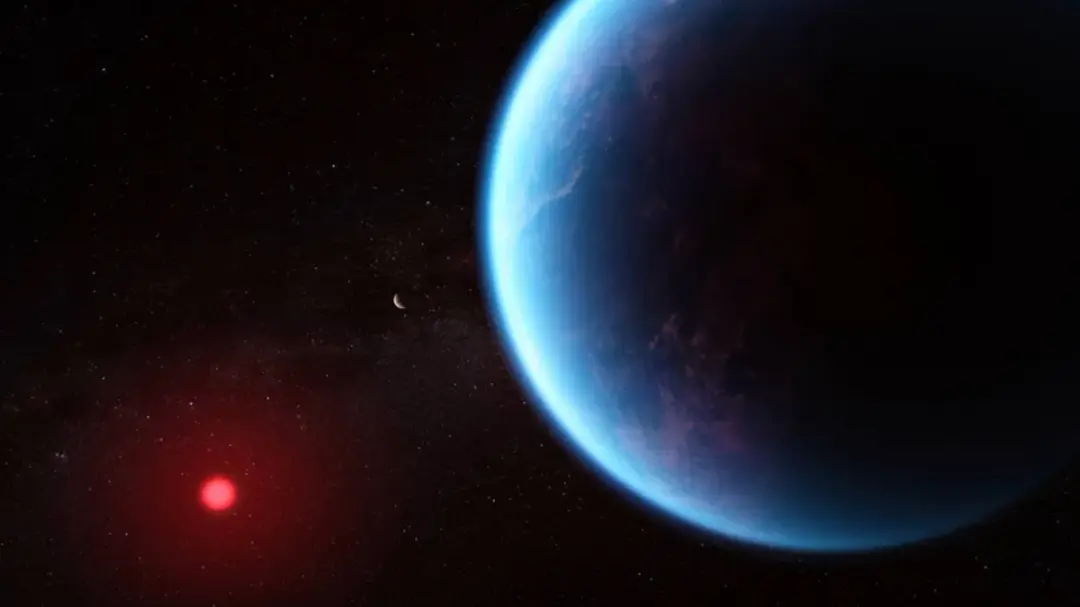
Is K2-18b an inhabited planet? Many people say "no".

 Is K2-18b an inhabited planet? Many people say "no". 


The K2-18b is a mini Neptune. The planet's mass is about 8 times of Earth. And the distance to that planet is 124 ly. The JWST found some "weak signs of life" on that planet. K2-18b habitable zone but that doesn't mean that there are lifeforms. 

The temperature of K2-18b is about zero Celsius. There is no ocean in that planet's atmosphere. But there is a water vapor. But the planet itself is dry. And that means there are no endemic advanced lifeforms. 

The JWST telescope found these elements from K2-18b's atmosphere. 

-Methane

-Carbon dioxide

-Hydrogen

-and probably dimethyl sulfide from that planet's atmosphere. 

In some rumors, there are some kind of radio signals detected from that exoplanet. Those rumors are the result of misunderstandings. The "signs of life" that the JWST telescope sees are the gasses that JWST saw in that planet's atmospheric spectrum. Those signs are interesting. But they are not straight technosignals. 

The radio or techno signals from dry planets that cannot host life can mean that something that comes outside that solar system made the base on that planet. That is one thing that we should think about. When we research the signals that the origin is or seems to be outside our solar system. 

Same way. We can conclude that "weak techno signals" are signs of just starting industrialization. But if those signs come from a dry world. That cannot be habitable. That could also tell about the alien base on those planets. 

"The most common “sized” world in the galaxy is a super-Earth, between 2 and 10 Earth masses, such as Kepler 452b, illustrated at right. But the illustration of this world as “Earth-like” in any way may be mistaken, as it’s more likely to either have a large, volatile gas envelope, making it a mini-Neptune, or to be a hot, stripped planetary core: like a scaled-up version of Mercury." (BigThink.com/Is K2-18b an inhabited ocean world? Don’t bet on it)


"When starlight passes through a transiting exoplanet’s atmosphere, signatures are imprinted. Depending on the wavelength and intensity of both emission and absorption features, the presence or absence of various atomic and molecular species within an exoplanet’s atmosphere can be revealed through the technique of transit spectroscopy. JWST cannot get spectra for Earth-sized planets around Sun-like stars, but Habitable Worlds Observatory finally will". (BigThink.com/Is K2-18b an inhabited ocean world? Don’t bet on it)


"The CHEOPS mission discovered three planets around the star Nu2 Lupi. The innermost planet is rocky and contains only a thin atmosphere, while the second and third planets discovered have large, volatile-rich envelopes. Although some are still calling them super-Earths, it’s very clear that not only are they not rocky, but most of the planets we call super-Earths are not like Earth at all in any meaningful way. This extends to all exoplanets with a radius above 1.7 Earth radii, with many of smaller sizes still having hydrogen and helium envelopes". (BigThink.com/Is K2-18b an inhabited ocean world? Don’t bet on it)


"This plot shows the spectrum, from 0.8-5.0 microns, of exoplanet K2-18b as taken with JWST. The signal is shown with data points with error bars; the interpretation of the signal by the discovering group is shown alongside it." (BigThink.com/Is K2-18b an inhabited ocean world? Don’t bet on it)


"What do planets outside our solar system, or exoplanets, look like? A variety of possibilities are shown in this illustration. Scientists discovered the first exoplanets in the 1990s. As of 2023, the tally stands at just over 5,000 confirmed exoplanets. None are known to be inhabited, but a few raise tantalizing possibilities: largely among the Earth-sized planets, not the super-Earth-sized ones". (BigThink.com/Is K2-18b an inhabited ocean world? Don’t bet on it)

But then I must return to the BLC-1 from Proxima B. 


The radio signal from Proxima Centauri B can have multiple origins. They could be some kind of plasma reflection from that planet's Van Allen belt. When some extraordinarily strong supernova blast happens that thing can send radio waves to Proxima B:s plasma belts. 

The Proxima B is a dry quite cold exoplanet. The surface temperature average is -39C. That means there could be oceans inside the ice. But there are no, at least endemic civilizations. This thing makes the Proxima B signal even more interesting than it has been. The thing that makes the BLC-1 signal interesting is that it does not repeat. The unique types of signals like BLC-1 and WoW! are the things that make them interesting. 


What could be the origin of the radio signals?

1) The signal could be a reflection from plasma rings around that planet. 

2) Signals can reflect anywhere between that planet and Earth.

3) Signal is created something that we cannot even imagine.


So if there are some kind of radio signals from that direction. The conditions on that planet make this situation quite complicated because that signal probably doesn't come from Proxima B. Or even if that signal comes from that direction could be a reflection from its Van Allen belt. The plasma belt that surrounds planets can reflect radio signals. And the origin of those signals can be anywhere in space. 


There is one interesting hypothesis about the WoW! and BLC-1 signals. 


One possibility is the probe that is sent by some other civilization. If we think that the signal happens only once there is the possibility that the signal can be the call signal. In that case, the probe acts like a computer. When it connects to the internet. It sends the call signal to the base or server that it is ready, and then the server or base sends the unique channel for the probe. 

The idea is that the probe, controlled by highly advanced AI has been in shutdown condition while it travels in space. When it arrives in the solar system, Proxima Centauri. It wakes up and makes its landing process fully automatic. Then that probe sends a signal that it's ready for work. 


In that hypothesis, the alien civilization that sent that probe saw the radio transmissions from the direction of Alpha Centauri. They might think that the signals are coming from Alpha Centauri, not the yellow star behind that triple star. And then they send probes to that solar system seeking another civilization. The idea of that hypothesis is that also humans are sending techno signatures around the universe. 


https://en.wikipedia.org/wiki/Proxima_Centauri_b


https://en.wikipedia.org/wiki/K2-18b


https://en.wikipedia.org/wiki/BLC1


https://en.wikipedia.org/wiki/Wow!_signal


Tuesday, September 12, 2023

Webb found carbon dioxide and methane in the exoplanet's atmosphere.

 Webb found carbon dioxide and methane in the exoplanet's atmosphere. 


Exoplanet K2-18b is an ocean planet, an 8,6 times Earth's mass world, that is covered by ocean. The planet's size is something between Earth And Neptune. The planet is one of them that orbits a red dwarf in its habitable zone. And that thing makes those findings interesting. 

The water world might not host intelligent lifeforms. But there is a possibility that in that giant ocean swims some kind of organisms. The existence of those organisms like cells and amoebas, and probably fish-like creatures, is not sure. 

Confirming those things requires more observations. But methane and carbon dioxide are promising things that could show the existence of some underwater organisms. But the distance to K2-18b is 120 light years. 


And that means we cannot confirm the existence of those hypothetical primitive creatures. And at that point, I must say that at least on Earth even the tiniest organisms traveled through as long evolution as humans. And that thing causes interesting visions. Confirming the existence of the fish-shaped, non-intelligent aliens is far more difficult than confirming the intelligent and technically advanced race's existence. 

The reason for that is the intelligent, technically advanced civilization leaves technical signatures like pollution and night lights. The problem is that if the aliens are at the level of cavemen they would not leave strong technical signatures. 

The water layer protects those lifeforms against the red dwarf's flares. And that means the K2-18b is a good candidate for hosting primitive lifeforms. In some visions, the future astronauts could live under the ice in stations that hover in oceans of Jupiter and Saturn's icy moon. In that case, the water layer covers astronauts against cosmic radiation. 

There is the possibility that primitive lifeforms that could look like crustaceans or fishes could be quite common in the universe. The thing is that those lifeforms are interesting, and if somebody could confirm to find a planet that hosts extraterrestrial lifeforms that would be a scientific sensation. But those primitive lifeforms are not a thing that affects us. The thing that researchers want and are afraid to find is an intelligent, technically advanced culture. 


https://interestingengineering.com/science/water-on-exoplanet-k2-18b-webb-finds-possible-molecular-clues

https://scitechdaily.com/beyond-earth-webb-space-telescope-detects-key-molecules-on-exoplanet-k2-18-b/

Tuesday, March 22, 2022

How to detect exoplanets?


The film above this text introduces some methods. The fact is that there are multiple methods how to find those mysterious and fascinating worlds. 

The most common way to find the planets that are orbiting red dwarfs is to detect the planet's gravitational effect on stars' specific movement. Specific movement is the trajectory that the star follows when it orbits the center of the Milky Way. 

If the trajectory is curving there is a planet that causes those changes. The neutron star or black hole causes radiation. So if there is a dark object that is the possible planet. 

If the planet orbits a red dwarf there is easy to detect the changes in the brightness of that star. That requires that the planet orbits the star by using trajectory, where it goes between star and Earth. 

But if the planet ever gets between star and Earth there is no chance to detect the changes in brightness. The limit of those methods is that they cannot use in the case of yellow or some bigger stars. The red dwarfs are not very kind places for the advancement of lifeforms. The red dwarfs are erupting stars. 

And their planets are locked by the tidal forces. So there is impossible to form higher lifeforms. But for the hypothetical advanced civilizations, those red dwarfs can give the excellent position to make an outpost. Livin on those red dwarf "habitable planets" requires the ability to make shields, but if the species can make that thing. 

The red dwarf and locked planets offer unlimited solar energy sources for those hypothetical space travelers. But that requires that the lifeforms are formed somewhere else. 

The other way is to see the planet's gravitational effect on the interplanetary nebula. The planet can cause the bubble of thicker material in that nebula. Because the planet's gravitational collects particles around it. 

Or the planet is making a hole in the disk of interplanetary nebula like so-called shepherd moons are making in the rings of planet Saturn. Also when the high-energy particles impact the planet's atmosphere. That causes the X-ray emission. And that X-ray emission uncovers planets near bright stars.

There is the possibility that also bright blue stars have planetary systems. There is a suspected exoplanet near Beta Centauri. The X-ray emission tells that there is the possibility that there is so-called hot Jupiter near that extremely bright star. But that planet would be extremely short living and extremely hot. If it exists. The b Centauri main star has the light power of 9500-13000 suns. And that thing covers even the other participants of this triple star. But even if that planet is the shining furnace that finding could be very interesting even if it's far from habitable. 


https://skyandtelescope.org/astronomy-news/giant-planet-imaged-around-massive-star/


https://en.wikipedia.org/wiki/Beta_Centauri 


https://thoughtsaboutsuperpositions.blogspot.com/


Could fast-spinning aerial vehicles be behind some UAP cases?

“The Phantom Twist drone’s unique rotation renders it almost invisible when in flight (Image Credit: Northwestern University).” (The Brief) ...